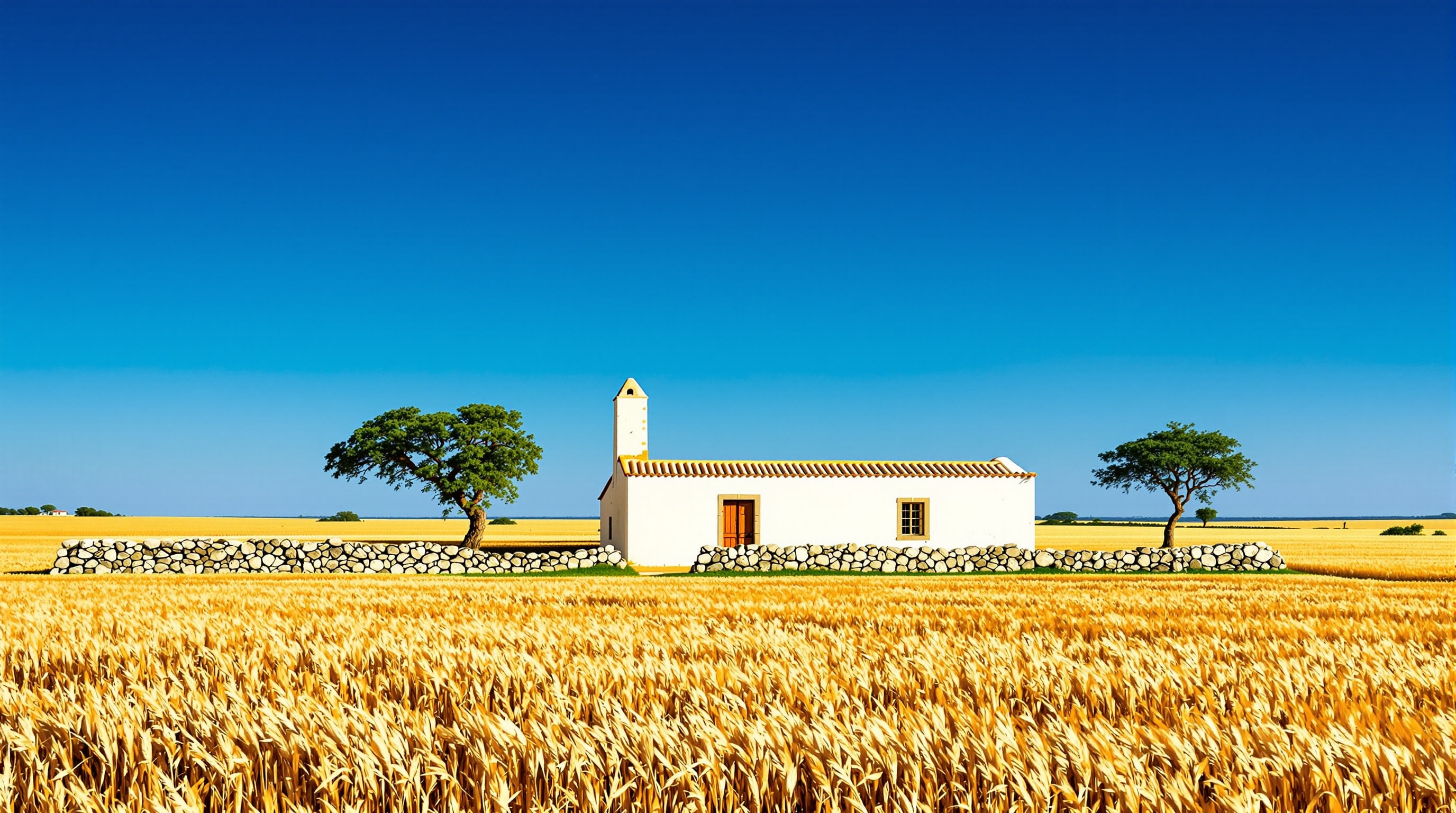
The Alentejo covers roughly a third of Portugal and holds about a twentieth of its people. It is a landscape of wheat, cork oak and olive stretching to a flat horizon, punctuated by whitewashed hill towns and by the low white farmsteads the region calls montes. Almost nothing here resembles the manor houses of the north — and that is precisely what makes it worth understanding on its own terms.
The Monte and the Herdade
The characteristic Alentejo estate is the herdade, a very large landholding — thousands of hectares is not unusual — worked historically by labourers rather than smallholders. Its buildings are the monte: a single-storey whitewashed range on the highest available ground, with a massive chimney at one end, small deep windows, and a huddle of outbuildings, storage sheds and a chapel around a bare yard.
The form is entirely practical. Whitewash reflects a sun that reaches the mid-forties in July. Walls half a metre thick hold the night's cool through the day. The chimney is enormous because it did the cooking and the smoking for a large working household. There are no formal gardens because there was no water for them, and often no coat of arms because these were working farms owned by families whose status came from acreage rather than from ancient title.
Évora and the Marble Towns
Évora is the regional capital and one of the finest historic towns in Iberia: a Roman temple standing in the middle of it, a medieval cathedral, an aqueduct running into the streets with houses built into its arches, and a complete ring of walls. The Historic Centre of Évora was inscribed by UNESCO in 1986, and the town has kept an unusually intact urban fabric of low whitewashed houses with yellow and blue trim.
North-east of Évora is the marble country. Estremoz, Borba and Vila Viçosa sit on one of the largest marble deposits in Europe, quarried since Roman times, and use it with a casualness that startles visitors — marble doorsteps, marble kerbs, marble field walls. Vila Viçosa holds the ducal palace of the House of Bragança, a very long marble façade facing an enormous empty square, open as a museum.
Castles, Frontiers and Megaliths
The eastern Alentejo was a frontier for eight centuries and it is fortified accordingly. Elvas, facing Spain across the Guadiana, is the largest bulwarked dry-ditch fortification in the world and was inscribed by UNESCO in 2012; Monsaraz, Marvão and Terena are perfect small walled towns on defensible hills.
Older still, the country around Évora holds one of the densest concentrations of megalithic monuments in Europe. The Almendres cromlech — a great oval of standing stones set up over centuries from around 6000 BC — predates Stonehenge by two millennia and is reached down a dirt track with almost no signage.
The Coast
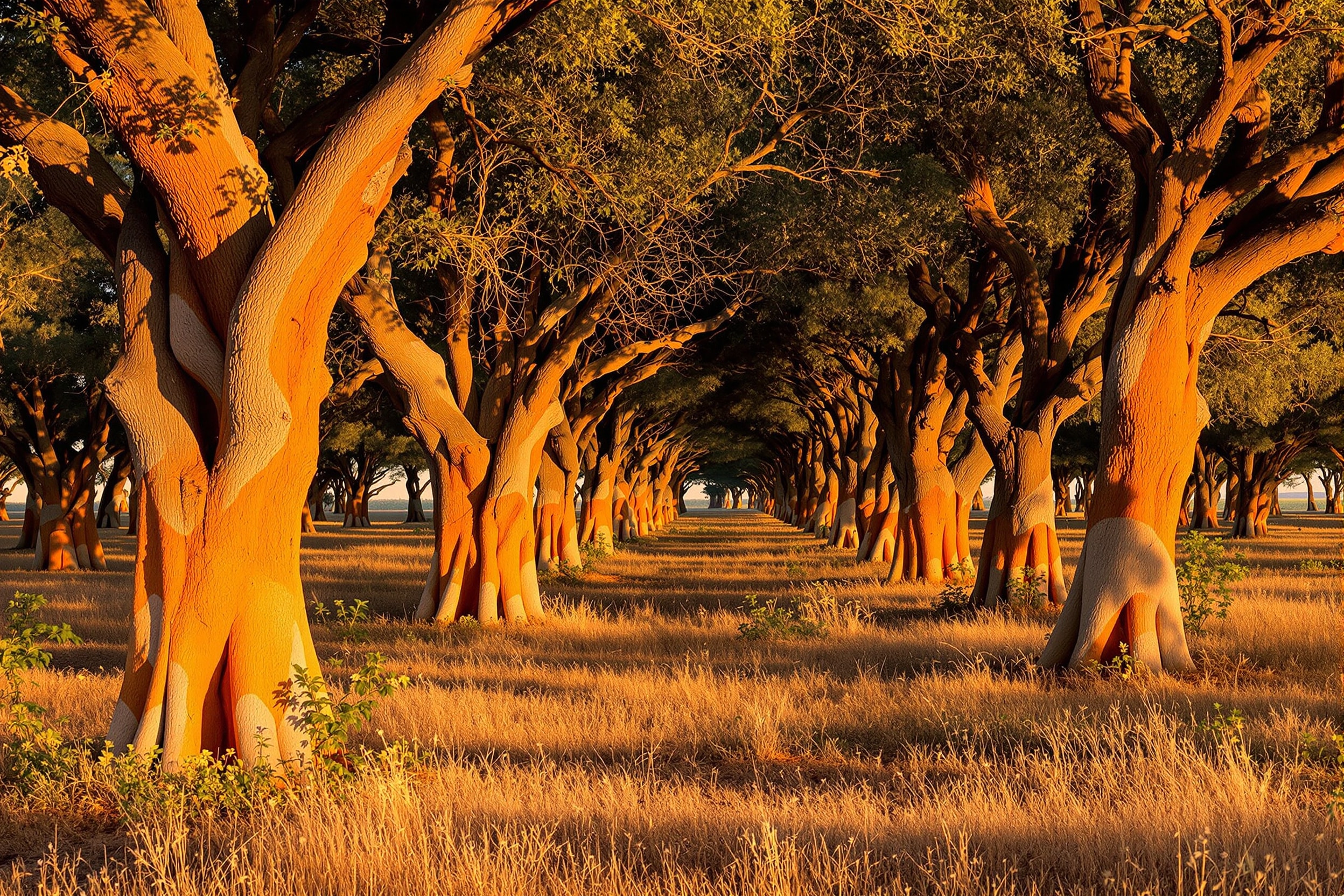
The Alentejo's Atlantic coast is the emptiest in southern Europe: a hundred and fifty kilometres of cliff, cove and dune from Sines to the Algarve border, protected as a natural park and almost entirely undeveloped. Small towns like Porto Covo, Vila Nova de Milfontes and Zambujeira do Mar sit above beaches that are cold, windy and spectacular. Inland from them the country is scrub and cork oak, sparsely populated even by Alentejo standards.
Staying in the Region
Because the Alentejo has relatively few classic manor houses, much of the region's heritage lodging is in converted montes and in the pousadas installed in castles and convents at Évora, Estremoz, Marvão, Beja and elsewhere — a pattern quite different from the north, where the private house is the norm.
Where private houses do open, they do so under the same Turismo de Habitação and rural-tourism categories used nationally, though a converted monte is more often classified as agroturismo or casa de campo than as Turismo de Habitação proper. The distinction matters and is explained on that page.
When to Go
Spring is the season. From March to early May the plain is green, the wildflowers are extraordinary and the temperature is pleasant; by late June the wheat is cut, the ground is the colour of a lion and the middle of the day is genuinely punishing. Autumn is a good second choice. See planning a journey and the orientation page, and note that the region borders both the Lisbon coast and the Algarve.