Lisbon has never really qualified as manor-house country. The rural-tourism grants that saved the northern solares were written for the countryside, and the capital is not that. But the hills immediately around it — Sintra above all — hold a concentration of country estates unlike anything else in Portugal, because for four hundred years the court came here to escape the summer.
Sintra
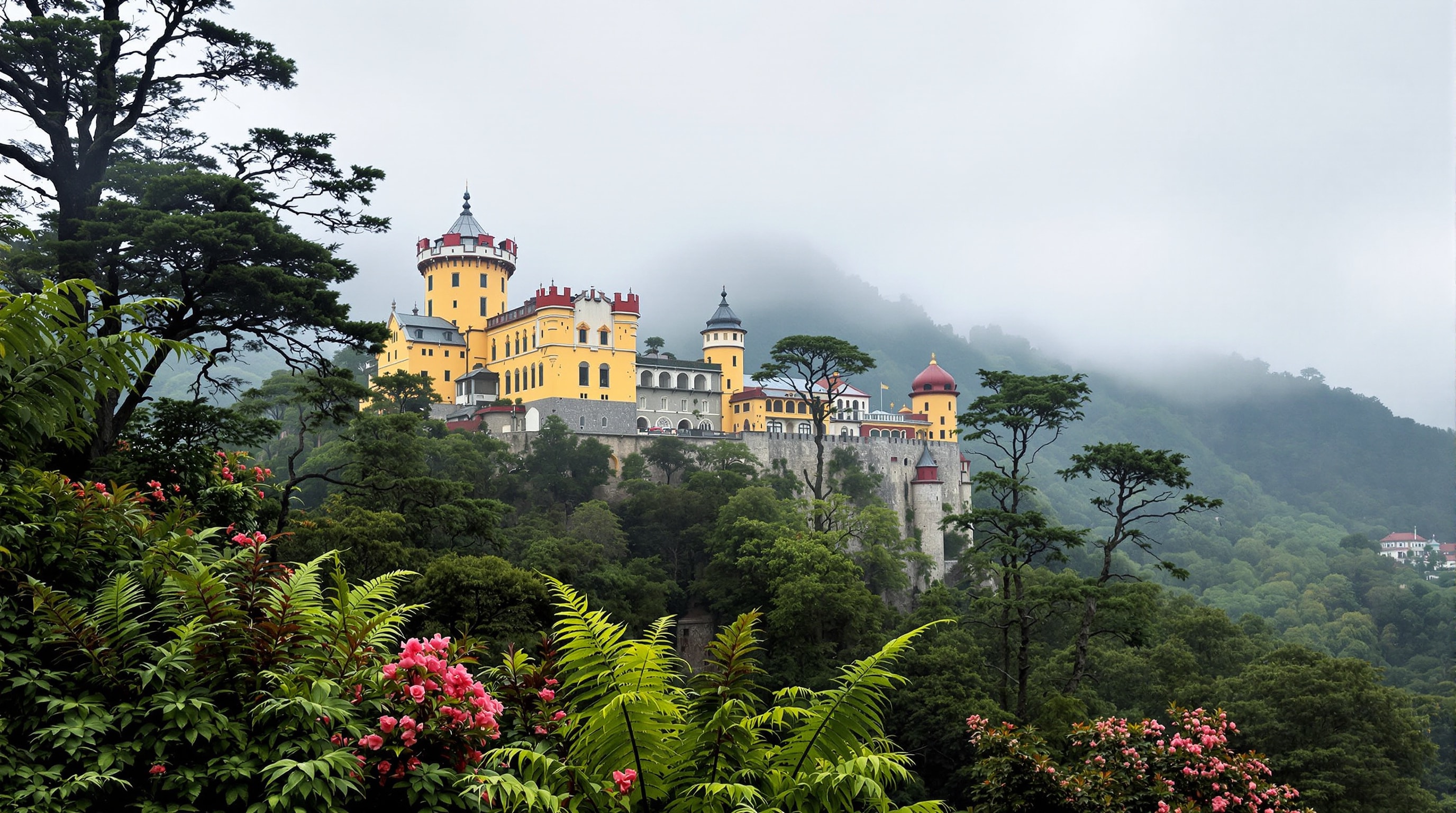
Sintra is a granite massif rising straight off the coastal plain and catching every scrap of Atlantic moisture, which makes it several degrees cooler than Lisbon and reliably damp. The result is a microclimate of tree ferns, camellias and mist that nineteenth-century romantics found irresistible, and that the medieval and early modern court had already appreciated for entirely practical reasons.
The Cultural Landscape of Sintra was inscribed by UNESCO in 1995 — the first European site listed in that category — precisely because it is not one building but an entire designed landscape of palaces, parks, estates and exotic planting. The National Palace in the town centre, with its two enormous conical kitchen chimneys, is the oldest surviving royal residence in Portugal. The Pena Palace on the ridge above is the great monument of Portuguese Romanticism: a nineteenth-century confection in yellow and red, built on the ruins of a monastery by a king consort with German tastes and no shortage of confidence.
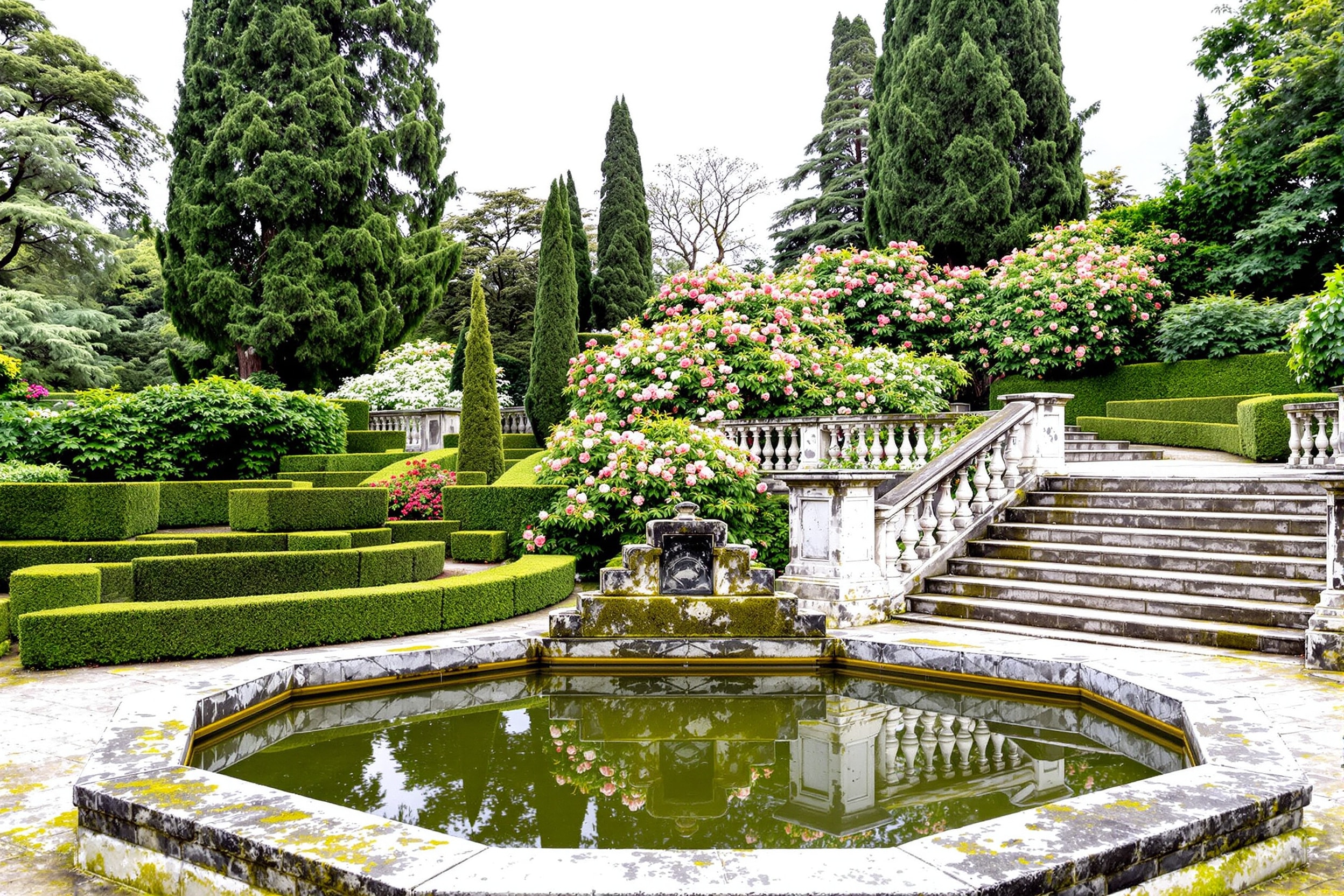
Around them, dozens of private quintas were laid out from the sixteenth century onward, and it is these rather than the palaces that constitute Sintra's manor-house stock. They are typically walled, heavily planted, and built into the slope with terraces and water — a different tradition entirely from the plain granite blocks of the Minho.
Cascais and the Estoril Coast
West and south, the coast turns to Cascais, a fishing town that became fashionable when the royal family began summering there in the 1870s, and stayed fashionable for the rest of the twentieth century. Cascais and neighbouring Estoril accumulated an unusual population of exiled European royalty and aristocracy in the 1940s and 1950s, and the villas and town houses from that period sit alongside earlier noble houses in the old centre.
The coast between Cascais and Cabo da Roca — the westernmost point of mainland Europe — is a protected stretch of cliff, dune and Atlantic surf within the Sintra-Cascais Natural Park.
Mafra, Ericeira and the Northern Edge
North of Sintra the country flattens into cereal and market gardening. Mafra holds one of the largest palace-convent complexes in Europe, a baroque monster of 1,200 rooms built with Brazilian gold in the 1730s, with a library of forty thousand volumes patrolled by a resident colony of bats that eat the insects. It was inscribed by UNESCO in 2019. Ericeira, on the coast below, is a whitewashed fishing town that became a World Surfing Reserve in 2011.
The Southern Bank
Across the Tagus the character changes again. Alcochete and the estuary shore look back at Lisbon across water that holds one of the most important wetland bird reserves in Europe — flamingos overwinter here in numbers. Inland the Setúbal peninsula runs to sandy pine country and vineyards; the fortified towns of Palmela and Setúbal guard the passes, and their castles are now among the best known of the country's heritage lodgings, on which see our page on the pousadas.
Beyond them the Serra da Arrábida drops in limestone cliffs to a Mediterranean-blue sea — geologically and botanically the odd one out on this Atlantic coast, and a natural park since 1976.
Houses and the City
The pattern here is different from the rural regions. Where a Minho solar was the permanent seat of a family who lived on and from its land, a Lisbon-coast quinta was very often a second house: a summer retreat for a family whose main business, income and social life were in the capital. That shows in the architecture — more garden, more terrace, more display and considerably less agricultural infrastructure.
It also affected what happened to them. Proximity to a growing capital meant land values rose rather than collapsed, so estates here were more likely to be broken up for development than to fall down. Fewer survive intact, and those that do are correspondingly more valuable. Some participate in Turismo de Habitação; more are private, and a number of the parks and gardens open to visitors.
Getting Around
This is the one region where a car is optional. Sintra and Cascais both have direct suburban rail links from central Lisbon, and Sintra in particular is far easier by train than by car, since the roads up to the palaces are narrow and the parking is hopeless. Elsewhere in the region a car helps. See planning a journey, the neighbouring Tagus valley, and the orientation page.