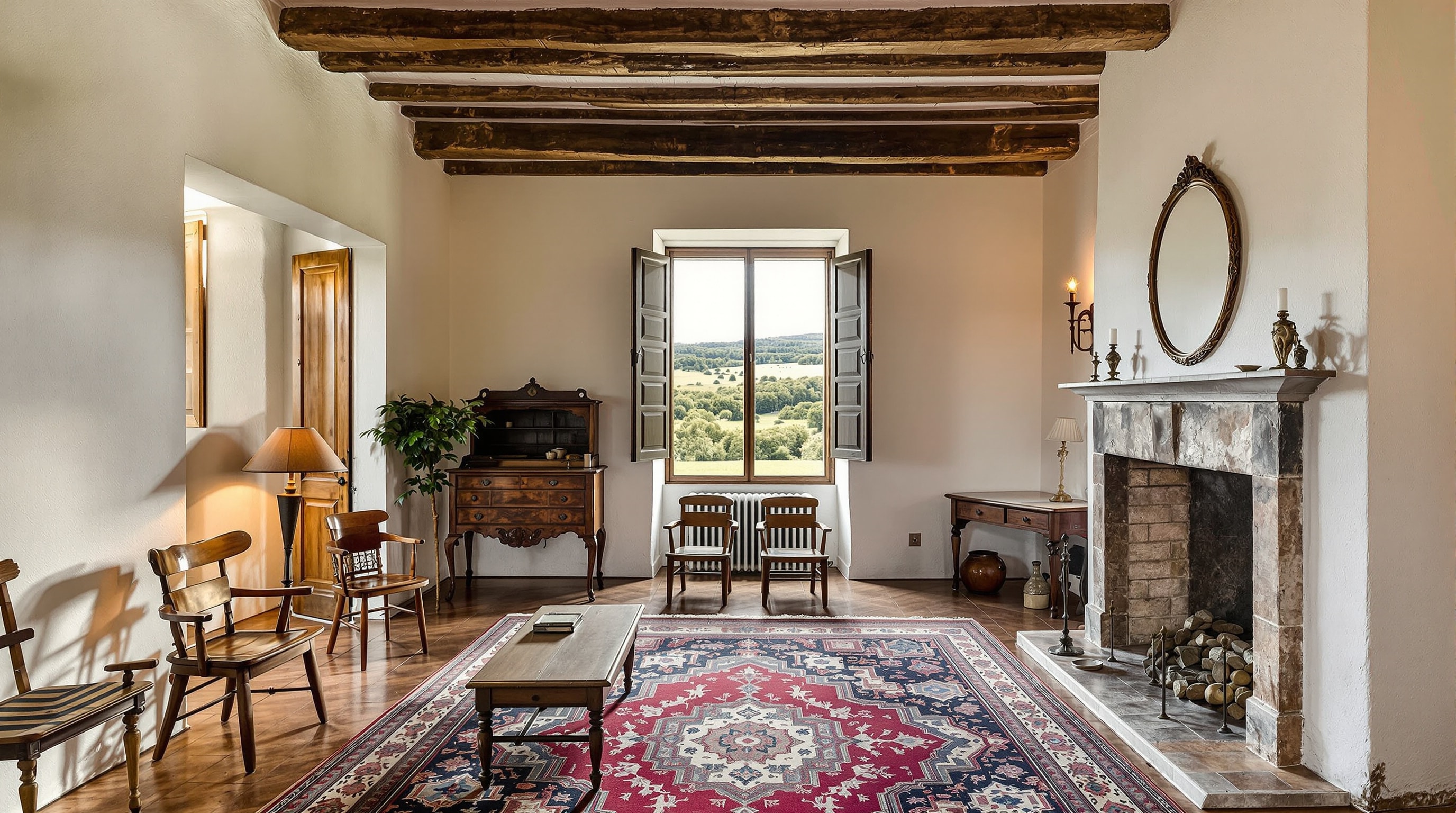
Portugal solved a problem that most of Europe never solved. By the 1970s its stock of historic country houses was collapsing — too expensive to run, too small to be museums, too big to be homes on an agricultural income. Rather than let them fall down or turn them into hotels, the state created a legal category that let owners take paying guests while continuing to live in the house. Several hundred buildings are still standing because of it.
The Problem It Was Built to Solve
A Portuguese solar of the seventeenth or eighteenth century is a large granite building with a chapel, outbuildings, walled gardens and often thirty or more rooms. It was built to be maintained by the income of an agricultural estate worked by a resident labour force, and by the mid-twentieth century that economic basis had gone. Rural wages rose, emigration emptied the countryside, and heirs who had moved to Lisbon or to France found themselves owning an enormous, cold, listed building in a valley they visited twice a year.
The choices were bad. Selling meant, in practice, selling to nobody: there was no market for such houses. Institutional conversion required capital nobody had. Demolition was often illegal and always a loss. Most owners simply closed off wings, moved into four rooms and watched the roof deteriorate — the standard trajectory of the European country house through the same period.
What the Scheme Does
The Portuguese response, developed through the 1970s and given firm legal shape in the 1980s, was a defined tourism category — Turismo de Habitação, usually shortened to TH — restricted to houses of recognised architectural, historic or artistic value, in which the owner continues to live. Guests take a small number of rooms in the family's house; there is no reception desk, no restaurant open to the public, and a legal cap on the number of rooms.
Attached to the classification were restoration grants, soft loans and technical guidance, initially with substantial European regional-development funding behind them. The bargain was explicit: public money towards a private roof, in exchange for a building conserved to standard and a modest tourism business that kept it in use.
The current framework, administered by Turismo de Portugal, keeps that shape. Requirements cover the architectural merit of the property, the standard of the restoration, and the character of the hospitality — a TH house is legally a house that receives guests, not a small hotel.
The Neighbouring Categories
Turismo de Habitação is the narrowest of several rural-tourism classifications, and the distinctions are worth knowing because Portuguese property descriptions use them precisely.
- Turismo de Habitação (TH) — an urban or rural house of recognised heritage value, architecturally distinguished, with the owner in residence. The classic solar or paço.
- Casas de Campo — country houses in villages or rural settings, in the local vernacular architecture but without the heritage classification. Often very attractive; not manor houses.
- Agroturismo — lodging on a working farm, where guests can see or take part in the agricultural activity. Many converted Alentejo montes and Douro quintas fall here.
- Hotéis Rurais — genuinely hotels, operated as such, in a rural setting. Perfectly good places to stay; a different proposition entirely.
A building's classification tells you what to expect of the experience rather than of its quality. A casa de campo may be more comfortable than a TH house; a TH house will be more historically interesting and more likely to involve a conversation with its owner over a glass of something at seven o'clock.
Why It Worked
Three features of the design deserve credit. First, it kept the owner in the building. A house with a family living in it is maintained continuously in a way an intermittently occupied one is not, and the whole character of the hospitality — the reason people travel for it — depends on that presence.
Second, it capped the scale. Without a room limit, the economics would have pushed successful houses towards expansion, conversion of the outbuildings, a restaurant, a spa, and eventually a hotel in a historic shell. The cap kept the buildings recognisably houses.
Third, it tied money to standards. Restoration grants came with technical conditions, which meant repairs were done in lime and granite and chestnut rather than in cement and uPVC — the single most important factor in whether a historic building survives its own restoration.
What It Is Not
It is worth being clear about the limits. The scheme is not a hotel chain, not a booking system and not a guarantee of any particular standard of comfort. Houses are independent, individually owned and individually run, and they differ enormously — from a formally staffed eighteenth-century paço to a granite farmhouse where the owner cooks breakfast. The classification says the building has heritage value and the owner lives there. Everything else varies.
Nor is it comprehensive. Many fine houses have never been classified, some because they take no guests and some because they chose a different category. The absence of a TH classification says nothing at all about a building's interest.
Reading About It Further
The national tourism authority publishes the current regulatory framework and the official register of classified properties; regional tourism boards hold local detail. For the buildings themselves, our architecture guide and glossary cover what you will be looking at, and the seven regional guides set them in their landscapes. On the related but distinct question of state-run heritage lodgings in castles and monasteries, see pousadas.