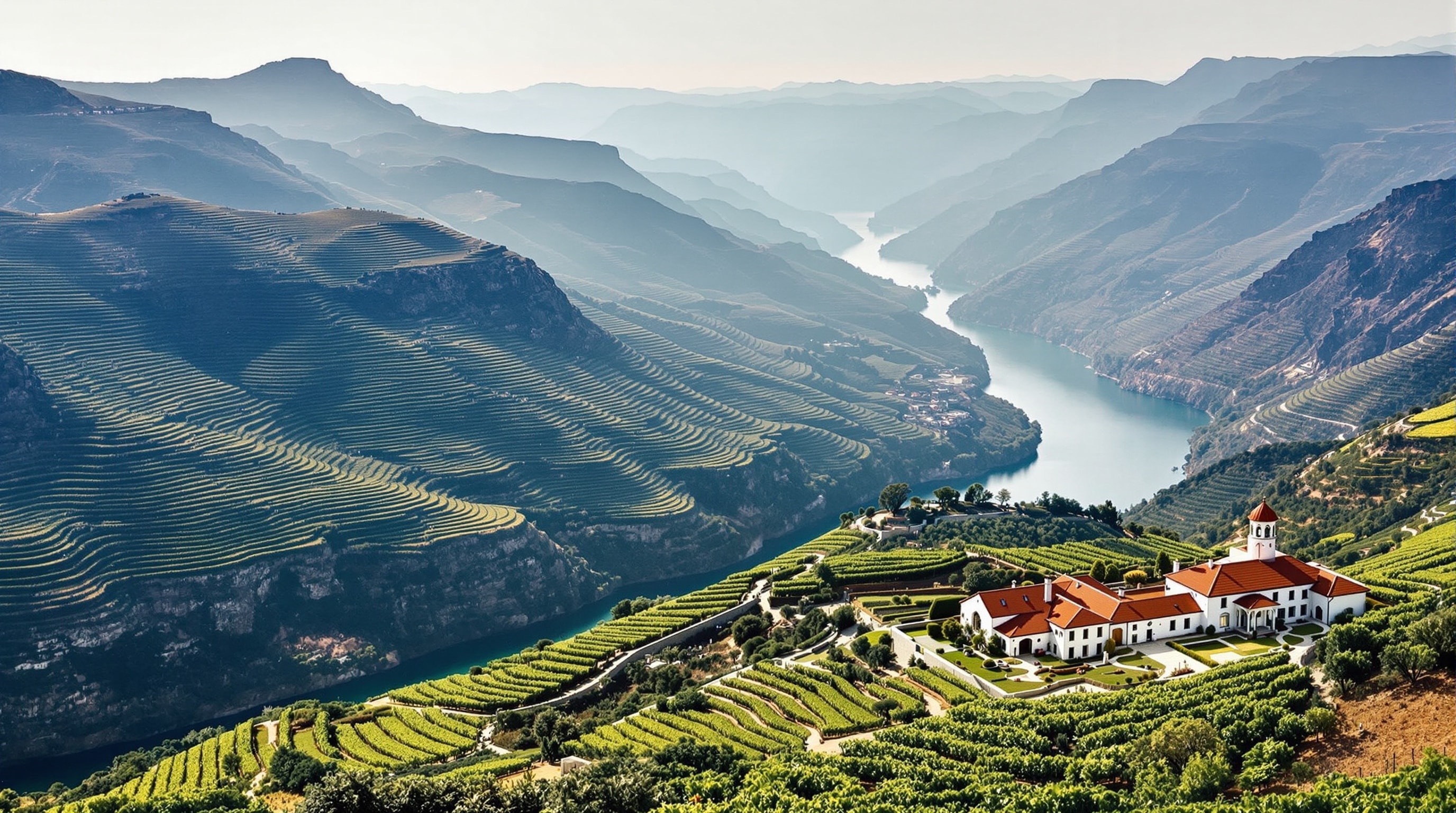
The Douro rises in Spain, cuts a gorge across the whole width of northern Portugal and reaches the Atlantic at Porto. Along the middle stretch of that gorge, on terraces cut into schist so steep that machinery still cannot work most of them, stand the quintas that make Port wine — the most distinctive estate landscape in Europe, and the reason this region's manor houses look nothing like those of the Minho an hour to the north.
Porto and the River Mouth
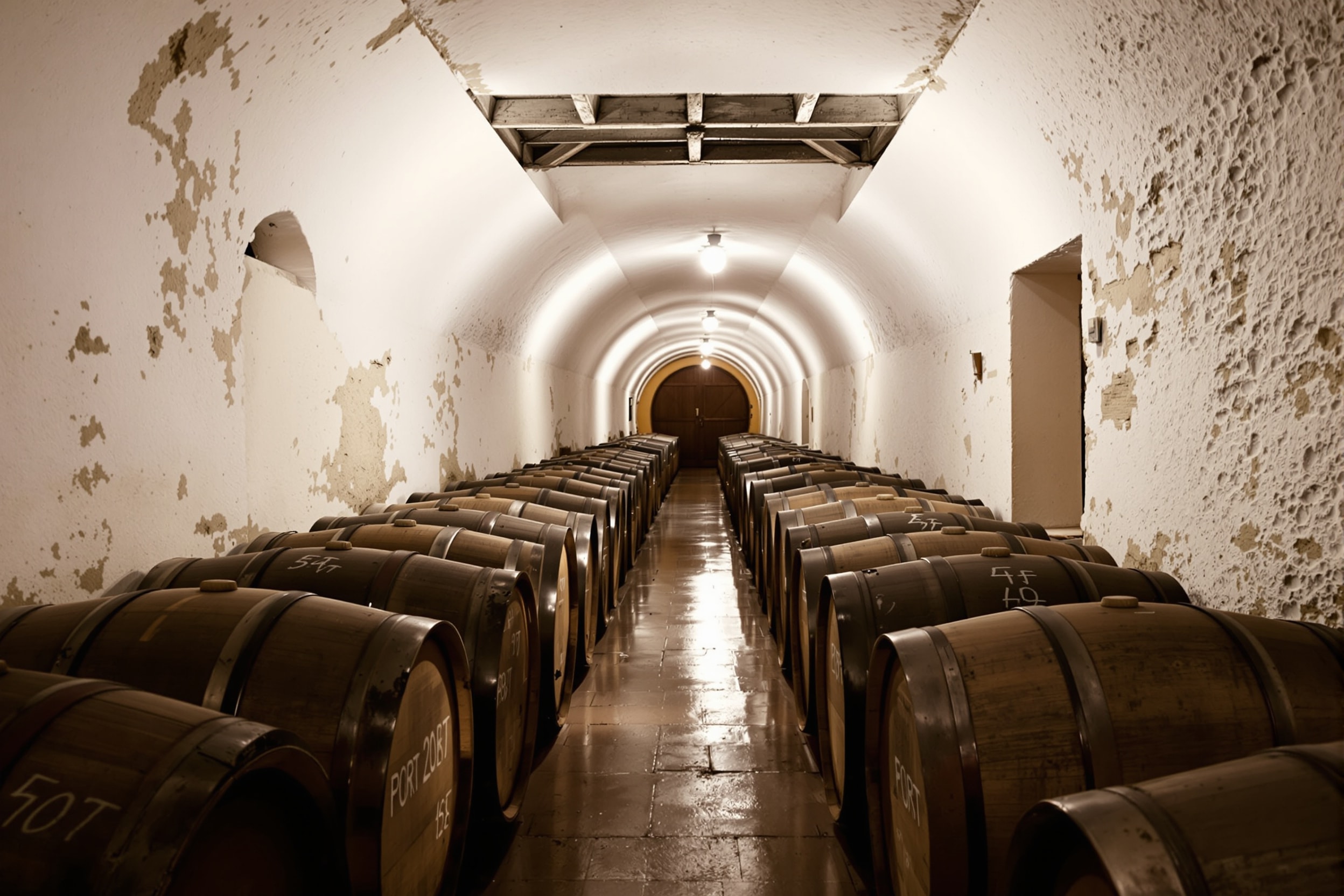
Porto is a granite city built on a hillside above a river mouth, and its historic centre — the Ribeira — was inscribed on the UNESCO World Heritage list in 1996. Facing it across the water in Vila Nova de Gaia are the lodges where Port has been aged and blended since the eighteenth century, long low buildings with shallow roofs designed to keep the temperature stable.
The city's own noble houses are urban rather than rural: tall, narrow granite fronts with iron balconies, tiled from first floor to eaves. The great estate houses begin as soon as you leave, along the coast towards Matosinhos and inland up the valleys of the Sousa and the Tâmega.
The Terraced Douro
East of Régua the landscape changes completely. The hills are schist rather than granite, the rainfall drops sharply, and the slopes above the river have been terraced by hand over three centuries into the socalcos that define the region. The Alto Douro Wine Region was inscribed by UNESCO in 2001 as an evolved cultural landscape — a working agricultural system rather than a monument.
The Douro is also the oldest demarcated and regulated wine region in the world. Boundaries were fixed in 1756 under the Marquês de Pombal, complete with a classification of vineyards and a state monopoly on the trade; the Instituto dos Vinhos do Douro e do Porto still administers the demarcation today. Our page on the Port wine quintas goes into the estates and the trade in more detail.
Quinta houses here are typically white-rendered rather than bare granite, long and low, with wide verandas and a tiled roof pitched to shed a fierce summer sun. Many are working wineries first and houses second — the lagares, the press house and the storage cellars are as much part of the architecture as the family rooms. Beyond Pinhão and the confluence of the Tua the terraces thin out and the country turns to almond and olive.
The Upper River and the Côa
At the far eastern end of the region, near the Spanish border, the Côa valley holds one of the most important open-air rock-art sites in the world: thousands of engraved figures on schist outcrops, cut over roughly twenty thousand years of the Upper Palaeolithic. The site was inscribed by UNESCO in 1998 after a dam project that would have flooded it was abandoned. It is a long drive from anywhere and worth the trouble.
Guimarães, Braga and the Northern Edge
The northern part of this region belongs geographically to the Minho and its house styles reflect that. Guimarães was the seat of the county from which Portugal itself emerged in the twelfth century, and its exceptionally intact medieval centre is another World Heritage site. The Paço dos Duques de Bragança, a fifteenth-century ducal palace, dominates the hill above the town and is open to the public — the nearest thing in the region to a manor house you can simply walk into.
Braga, a few kilometres west, is the ecclesiastical capital of Portugal and has been an archbishopric since the Roman period. The baroque stairway of Bom Jesus do Monte outside the city, a granite zigzag of chapels and fountains climbing a wooded hill, is the best single demonstration of what eighteenth-century northern Portuguese baroque could do with stone and whitewash — the same vocabulary the solares use, at monumental scale.
Wine, Landscape and the Estate House
What distinguishes the Douro from every other manor region in Portugal is that the houses were never merely residential. A Minho solar was the seat of a family that happened to farm; a Douro quinta is a production unit that happens to have a fine house on it. That shapes everything — where the buildings sit on the slope, how they are laid out, what the outbuildings are for, and why so many kept working through periods when family fortunes did not.
It also means the region weathered the twentieth century better than most. Port remained an export business through decades when subsistence agriculture collapsed elsewhere, so a proportion of Douro estates never needed rescuing at all. Where houses did open to guests, they did so under the same Turismo de Habitação framework used in the north.
Getting Around
The Douro line railway from Porto to Pocinho follows the river for its final stretch and is one of the great scenic railways of Europe; the section between Régua and Pinhão is spectacular. By road, the riverside route along the south bank covers similar ground more slowly. Distances look small on a map and take much longer than expected — see planning a journey — and the regional orientation page sets the Douro in relation to the neighbouring Alto Minho and Beiras.