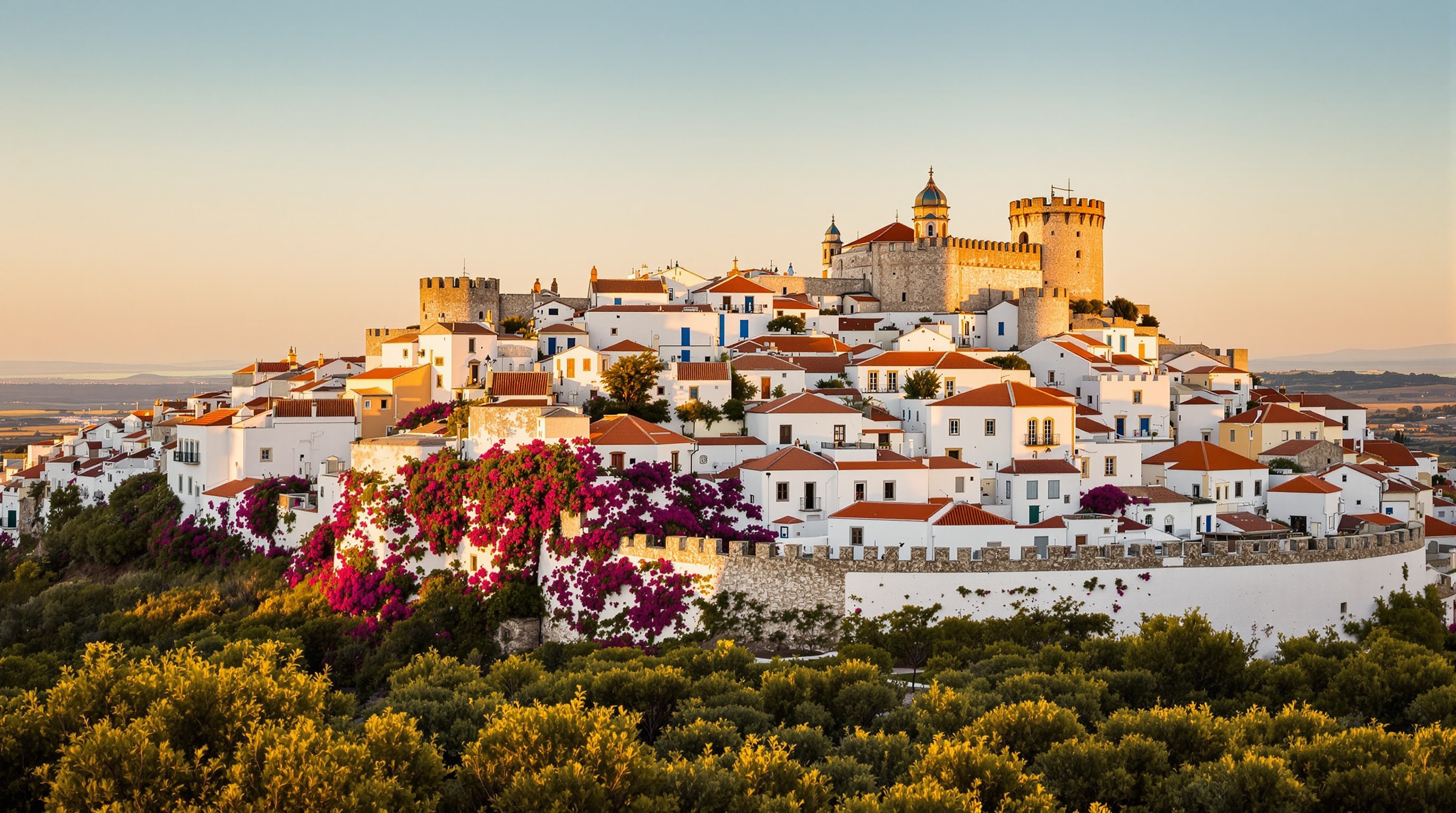
The country north and east of Lisbon is the historical centre of Portugal in a way no other region is. Three of the greatest Gothic buildings in Europe stand within an hour of each other here; the walled town of Óbidos was a queen's personal property for five centuries; and the flat land along the Tagus has bred fighting bulls and Lusitano horses for as long as records exist. The manor houses of the region reflect all of it.
Óbidos and the Estremadura Coast
Óbidos is a complete walled town on a low hill above a former lagoon: a single main street of whitewashed houses banded in ochre and blue, a circuit of walls you can walk, and a castle at the top that has served as a lodging since the 1950s. From 1282 it was given by King Dinis to his queen and remained part of the dowry of the queens of Portugal until the nineteenth century, which is why it was never rebuilt or absorbed into anything larger.
The country around it — the Estremadura — is gentler than the north, with vines, orchards, pine and a long line of Atlantic beach from Peniche down to Ericeira. Manor houses here tend to be lower and whiter than their northern equivalents, built of limestone and lime render rather than granite, with the deep-set windows and heavy cornices of the central Portuguese tradition.
The Abbey Country
Within a short drive of Óbidos stand three of the most important religious monuments in Portugal, all inscribed by UNESCO.
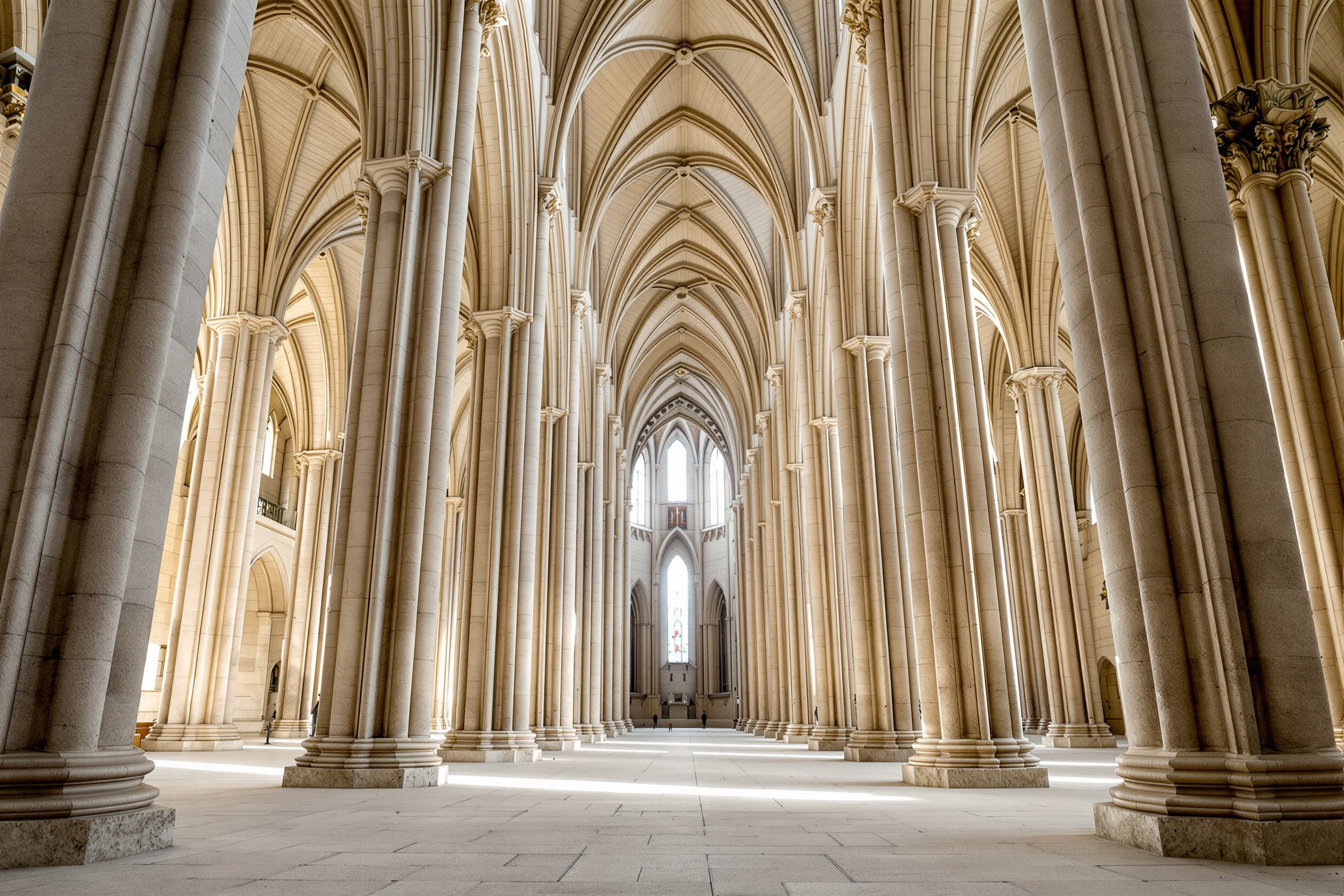
Alcobaça is a vast Cistercian monastery founded in 1153, the earliest fully Gothic building in the country, with a kitchen through which a diverted river once ran and the tombs of Pedro I and Inês de Castro facing each other across the transept. Batalha, begun in 1386 to commemorate the victory at Aljubarrota, is the great set piece of Portuguese late Gothic, complete with a roofless octagonal mausoleum abandoned mid-construction when the money and the interest went elsewhere. Tomar, further inland, is the Convento de Cristo — headquarters of the Knights Templar in Portugal and then of their successors, the Order of Christ, whose fortune from the Discoveries paid for the Manueline window that is probably the single most photographed piece of stone carving in the country.
These are not manor houses, but they explain the manor houses. The families who built country seats in this region were often connected to these institutions, held land from them, or were enriched by the same overseas expansion the Order of Christ financed.
Fátima and the Pilgrim Roads
Near Ourém, a modern pilgrimage town has grown around the site of the 1917 Marian apparitions. It draws very large numbers of visitors in May and October, which is worth knowing when planning a stay anywhere within about thirty kilometres in those months. Outside those weeks the surrounding limestone country — the Serras de Aire e Candeeiros, riddled with caves — is quiet and largely undiscovered.
The Ribatejo Plain
East and south, the Tagus spreads into a broad alluvial plain, the lezíria, that floods in winter and dries to grazing in summer. This is horse and bull country. Around Santarém and Golegã the estates are large, low and agricultural, closer in spirit to the Alentejo montes than to a northern solar, with long ranges of stabling and a working yard at their centre. Golegã's November horse fair is one of the oldest continuous agricultural events in Portugal.
Santarém itself sits on a bluff above the river with a run of Gothic churches and one of the best viewpoints in central Portugal. Downstream, Vila Franca de Xira keeps the bull-running traditions of the plain alive.
What to Expect of the Houses
The Tagus region never had the Minho's density of noble families and it lost more of its houses to the twentieth century. What survives divides into three types: small fortified-looking quintas of the fifteenth and sixteenth centuries; comfortable eighteenth-century country houses within reach of Lisbon, built as summer retreats by families whose main residence was in the capital; and working agricultural estates out on the plain. All three are represented in the Turismo de Habitação classification.
Limestone rather than granite gives the region its colour. Where the north is grey and green, this is white, ochre and pale gold, and the tile work runs to the blue-and-white narrative panels of the eighteenth century rather than the geometric patterns of the north — see the architecture guide.
Practicalities
The whole region lies within about ninety minutes of Lisbon by motorway, which makes it the easiest manor-house country in Portugal to reach and the most practical for a short trip. It combines naturally with the Lisbon coast to the south and the Beiras to the north; the orientation page covers the distances.